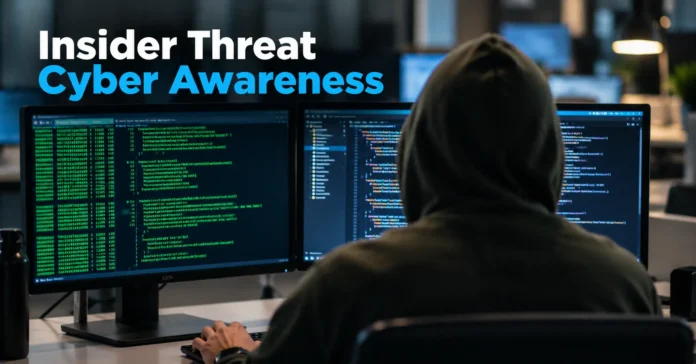
Insider threat cyber awareness is the practice of training people to recognize, prevent, and report security risks that come from inside an organization, meaning employees, contractors, or vendors who already have trusted access.
Most damaging breaches don’t start with a hooded stranger breaking through a firewall. They start with someone who already holds the keys, acting either carelessly or with intent.
That’s what makes insiders so hard to stop. A trusted user logs in with valid credentials, opens files they’re allowed to open, and moves data they’re allowed to touch.
Nothing trips the alarm. This is why awareness, not just technology, sits at the center of any real defense.
What is an insider threat?
An insider threat is a security risk that comes from someone associated with the organization: a current employee, a former employee with lingering access, a contractor, a consultant, a vendor, an intern, or a business partner.
The U.S. Cybersecurity and Infrastructure Security Agency defines it as the risk that an insider uses their authorized access, wittingly or unwittingly, to harm the organization, including its people, data, systems, or facilities.
The harm takes many forms: stealing or leaking data, selling company secrets, sabotaging systems, misplacing a laptop, emailing a sensitive attachment to the wrong person, misconfiguring a database, or simply falling for a phishing scam.
It helps to separate two terms that often get mixed up. Insider risk is the umbrella: every internal activity that could expose data, intended or not.
Insider threat is the sharper edge: an insider whose actions actually create potential for harm. Getting this distinction right shapes how a security program spends its time and budget.
The four types of insiders
Not every insider is a villain. They fall into clear categories, and each needs a different response.
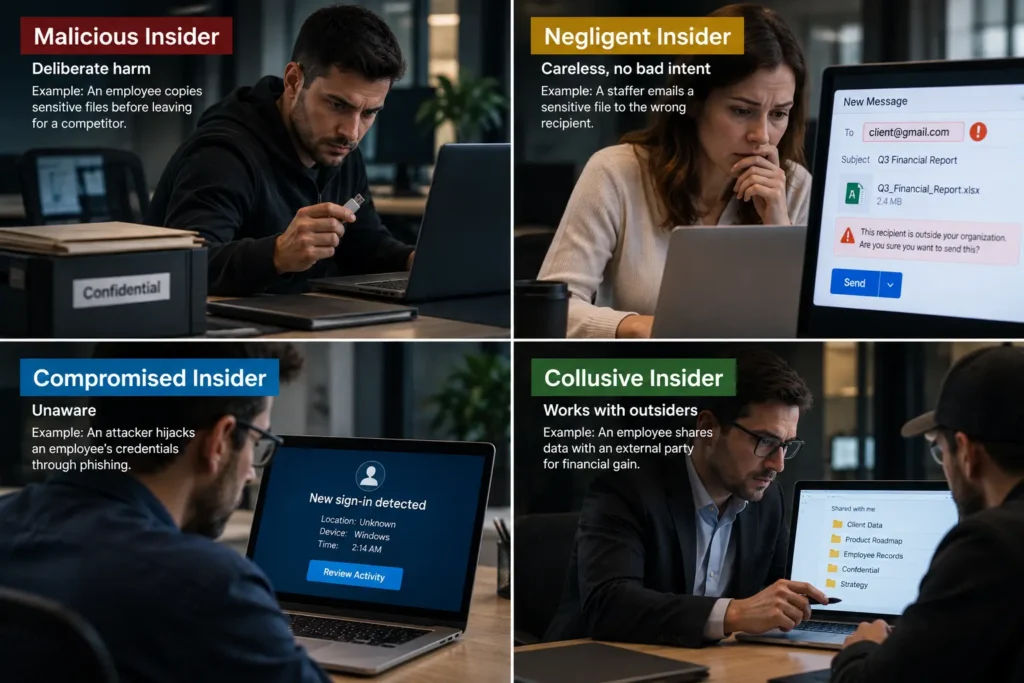
| Type | Intent | Example |
| Malicious insider | Deliberate harm | An engineer copies source code before quitting for a competitor |
| Negligent insider | Careless, no bad intent | A staffer reuses a weak password or emails a file to the wrong client |
| Compromised insider | Unaware | An attacker hijacks a real employee’s credentials through phishing |
| Collusive insider | Works with outsiders | An employee feeds data to an external criminal group for money |
Malicious insiders are the nightmare scenario, but they’re the minority. The majority of incidents trace back to negligence: good people making bad choices without realizing the cost. Compromised insiders are the hardest to catch, because the activity looks like it’s coming from a trusted account. Collusive threats are the most destructive, pairing inside access with outside skill.
Why insider threat cyber awareness matters
External hackers are loud. They rattle the doors, trip sensors, leave traces. Insiders are quiet. They don’t need to break in, so traditional defenses like firewalls, intrusion detection, and perimeter controls often never see them coming.
The numbers make the case. A Verizon Data Breach Investigations Report analysis of 3,950 breaches found that roughly 30% involved internal actors.
Cost studies from the Ponemon Institute have repeatedly put the average annual price of insider incidents in the millions, with the largest share driven by negligence rather than malice.
Hybrid and remote work have widened the gap further: when people log in from home Wi-Fi, personal laptops, and coffee-shop networks, the organization loses visibility into what “normal” even looks like.
Part of the answer starts at the individual level, since the same habits that protect a home computer also reduce the risk a remote worker brings back to the company.
This is where awareness earns its place. Tools catch anomalies after the fact. A trained employee catches the odd request, the rushed email, the login that feels off, and reports it before it becomes a headline. Awareness turns the workforce from the weakest link into an early-warning system.
Warning signs: behavioral and technical indicators
Insider threats rarely announce themselves. But the signals are there for teams that know what to watch.
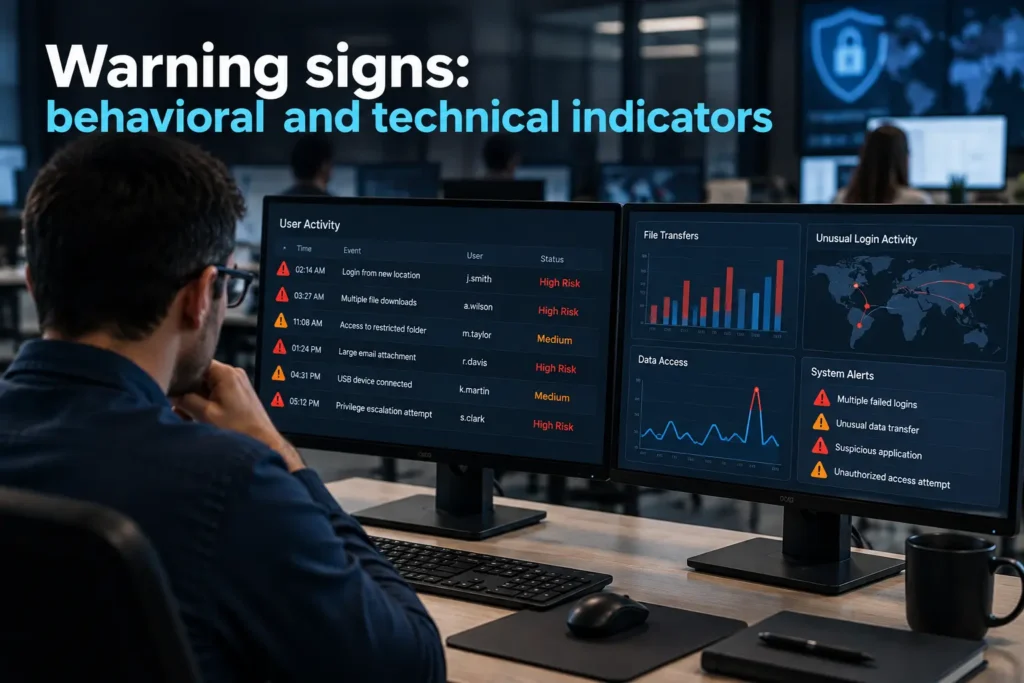
Behavioral indicators show up in how people act:
- Logging in or working at unusual hours for no clear reason
- Accessing files or systems unrelated to their role
- A sudden drop in performance, morale, or engagement
- Attempting to enter restricted areas
- Requesting elevated privileges without a valid need
- Behavior changes after a demotion, a passed-over promotion, or a resignation notice
Technical indicators show up in the systems:
- Downloading files en masse or copying data to USB devices
- Sending emails with unusually large attachments
- Transferring data from one cloud provider straight to another
- Using unapproved file-sharing apps or unmanaged devices
- Disabling security tools
- Making changes to many files in a short window
- Privilege escalation and data exfiltration attempts
No single sign proves anything, and an IT admin working late is not a criminal. But when several stack up at once, that’s the moment to look closer. Logging, analytics, and behavioral tooling make these patterns visible instead of invisible.
Real-world examples
The threat isn’t theoretical. In 2023, two former Tesla employees leaked the personal information of more than 75,000 workers to a foreign news outlet.
Coinbase disclosed in 2025 that criminals had bribed overseas support agents at a third-party vendor to steal data on roughly 69,000 customers.
Canada’s Desjardins credit union lost 9.7 million customer records to a single insider who copied data over two years, a breach that cost the company more than $100 million to clean up.
Different industries, different motives, same lesson: the person with legitimate access is often the biggest risk on the board.
How to build insider threat cyber awareness and prevention
Awareness works best as one layer inside a broader program. The strongest defenses combine culture, policy, and technology.
Control access tightly. Apply the principle of least privilege, giving people access to only what their job requires and nothing more. Use role-based access control so permissions map to responsibilities. Build toward a zero trust model, where every user and device has to verify identity for every request, even inside the network. Add multi-factor authentication (MFA) everywhere it fits.
Watch the data, not just the perimeter. Data loss prevention (DLP) tools stop sensitive files from leaving the environment. User Behavior Analytics (UEBA) flags activity that breaks a person’s normal pattern. Privileged Access Management (PAM) locks down high-risk admin accounts. Feed the signals into a SIEM so alerts surface early instead of after the damage.
Close the exits. Most insider damage happens after an easy step gets skipped: offboarding. The moment someone leaves, disable their accounts and revoke access to every internal system and third-party app. Stay especially alert during mergers and acquisitions, when permissions get reshuffled and gaps open up.
Train continuously, not once a year. A single onboarding session fades fast. Short, regular refreshers keep phishing, password hygiene, and reporting habits fresh. Teach people to keep passwords private, report missing equipment immediately, and recognize social engineering. For a proven public framework, the U.S. Department of Defense’s Cyber Awareness Challenge is the baseline standard for end-user training and a solid model to borrow from. For the security staff running these programs, formal cyber security certifications help build the expertise to design and lead them well.
Build a culture where people speak up. If employees fear punishment, they hide mistakes, and hidden mistakes grow. Reward good behavior, encourage honest reporting, and get HR, legal, IT, and compliance working together. CISA’s Insider Threat Mitigation Guide lays out a full four-step framework of define, detect, assess, and manage that any organization can adapt, not just critical infrastructure.
The 2026 outlook: AI and shadow AI
The risk is shifting. Employees now paste sensitive data into generative AI tools for a quick productivity win, often unaware that the information can be stored elsewhere or resurface later. This “shadow AI,” meaning unsanctioned tools used outside company policy, has widened the insider attack surface faster than most security teams can keep up. Attackers are using AI too, crafting phishing lures and deepfakes convincing enough to fool trained staff.
The takeaway isn’t to ban the technology. It’s to fold AI use into awareness training and set clear guidelines, so people understand where the new risks live.
Frequently Asked Questions
What is insider threat cyber awareness in simple terms?
It’s teaching everyone in an organization to spot, avoid, and report security risks that come from trusted insiders, whether those risks are accidental mistakes or deliberate acts.
Are most insider threats malicious or accidental?
Most are accidental. The bulk of incidents come from negligent insiders, meaning careless clicks, weak passwords, and misdirected emails, not people setting out to cause harm.
Who counts as an insider?
Anyone with authorized access: current and former employees, contractors, consultants, vendors, business partners, interns, and temporary staff.
What’s the difference between insider risk and insider threat?
Insider risk is the broad category of any internal activity that could expose data. Insider threat is the narrower case where an insider’s actions create real potential for harm.
Can technology alone stop insider threats?
No. Tools like DLP, UEBA, and SIEM catch a lot of attention, but they can’t cover every human mistake. Awareness training turns employees into an active line of defense that technology can’t replace.
What are the first signs of an insider threat?
Watch for access outside normal hours, mass downloads, large or unusual data transfers, requests for extra privileges, and behavior changes after a negative work event.
How often should awareness training happen?
Ongoing. Short refreshers monthly or quarterly beat a single annual session, because threats change and people forget.
Do remote workers increase insider risk?
They don’t make employees more dangerous, but they expand where and how data is accessed, which reduces visibility and makes awareness and monitoring more important.