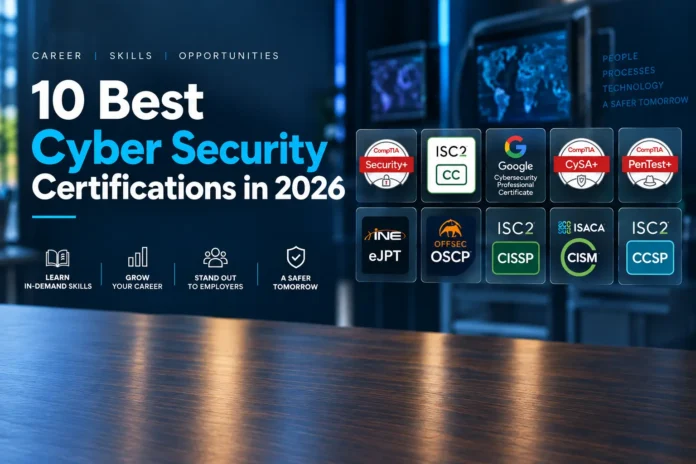
Choosing among the many cyber security certifications available in 2026 is less about picking the “best” one and more about picking the right one for where you are in your career. A beginner who signs up for CISSP will waste money. A ten-year security lead who starts with an entry cert will look overqualified on paper. The trick is matching the credential to your stage, your budget, and the job you actually want next.
This guide breaks down the ten cyber security certifications that still carry real weight with employers this year — what each one costs (with the 2026 price increases baked in), who it’s built for, and the requirements you need before you register. No filler, no ranking based on affiliate payouts. Just the numbers you need to budget properly and a straight answer on which one to choose.
A quick note before the list: exam vouchers, membership dues, and renewal fees change more often than people expect, and several vendors raised prices in mid-2026. Treat every figure below as a planning number and confirm the live price on the official site before you pay. Regional pricing and local taxes will shift the total too.
Quick Comparison: All 10 Certifications at a Glance
| Certification | Best For | Level | Exam Cost (USD, 2026) | Prerequisites |
| ISC2 CC | Absolute beginners | Entry | ~$199 | None |
| CompTIA Security+ | Career starters / IT pros | Foundational | ~$439 | None (Network+ recommended) |
| CompTIA CySA+ | SOC / blue team analysts | Intermediate | ~$425 | 3–4 yrs experience recommended |
| CEH (v13) | Ethical hacking, gov roles | Intermediate | ~$1,199 | 2 yrs experience or training |
| OSCP | Hands-on penetration testers | Advanced | ~$1,749 (bundle) | Strong networking/Linux skills |
| CISSP | Security leaders/architects | Expert | ~$749 | 5 yrs experience |
| CISM | Security managers / CISOs | Expert | $575 / $760 | 5 yrs management experience |
| CISA | Auditors/compliance | Expert | $575 / $760 | 5 yrs audit experience |
| CCSP | Cloud security specialists | Advanced | ~$599 | 5 yrs IT + 3 yrs security |
| GIAC GSEC | Technical practitioners | Intermediate | ~$979 | None (training recommended) |
Now let’s get into the details — starting with the certifications that make sense if you’re just getting in the door.
1. ISC2 Certified in Cybersecurity (CC)
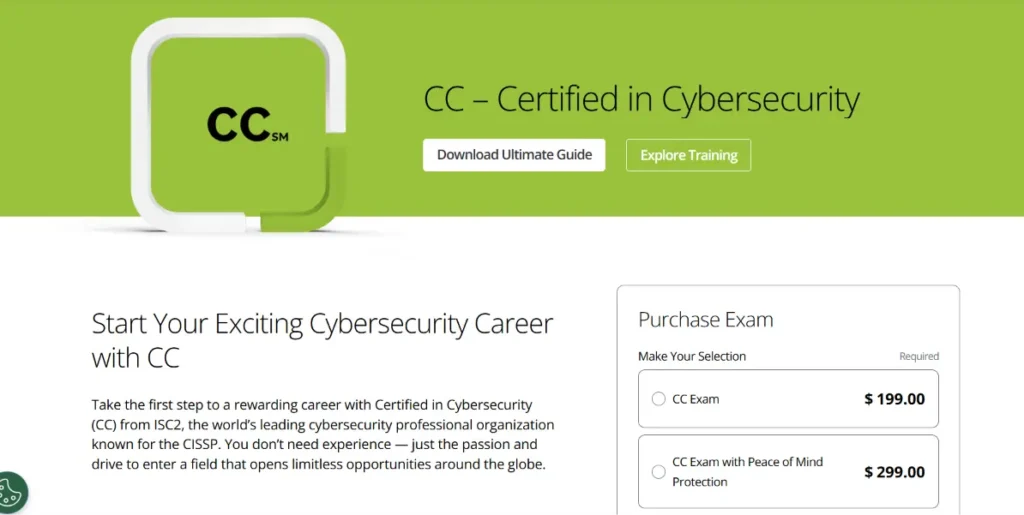
For years, the standard advice for beginners was “start with Security+.” That’s shifted. ISC2 — the same organization behind the industry-famous CISSP — built a genuine entry-level credential from scratch and, for a while, handed out free training and exam vouchers to over a million people to grow the workforce. That giveaway has now wrapped up.
Cost: The exam runs about $199 in major markets, with a $50 annual maintenance fee once you’re certified.
Requirements: None. This is the one certification on the list you can take with zero experience and zero prerequisites.
Format: A 100-question multiple-choice exam covering five foundational domains, pulled from real junior-level job tasks. The current outline shifts to a refreshed version effective September 1, 2026, so check which one applies to your test date.
Best for: Students, career-changers, or anyone who wants proof they understand core security concepts before spending real money on a bigger cert.
The CC’s biggest advantage is that it plugs straight into ISC2’s ladder — it sits below SSCP, CCSP, and CISSP, so it gives you a clean upward path if you plan to stay in the ISC2 family. The downside? It’s newer, so some hiring managers still don’t recognize it the way they recognize Security+.
2. CompTIA Security+
Security+ is the closest thing cybersecurity has to a universal starter credential. It’s vendor-neutral, it shows up in more entry-level job postings than almost anything else, and — critically — it satisfies U.S. Department of Defense 8570/8140 baseline requirements, which makes it non-negotiable for a lot of government and defense contractor roles.
Cost: The current SY0-701 voucher is $439 as of the June 2026 price increase (it was $425 before that). Renewal after three years costs $150.
Requirements: No formal prerequisites, though CompTIA suggests Network+ and a couple of years of IT experience first. Plenty of people pass it fresh.
Format: A single exam with a mix of multiple-choice and performance-based (hands-on simulation) questions. You need a scaled score of 750 out of 900 to pass. Those simulation questions are where underprepared candidates lose points, so lab practice matters as much as reading.
Best for: Anyone starting a security career, or an IT generalist pivoting into security.
Salary-wise, Security+ holders typically start in the $55,000–$75,000 range, with experienced professionals pushing well past $100,000 depending on role and location. For the price, the return is hard to beat.
3. CompTIA CySA+
Security+ proves you know the fundamentals. CySA+ (Cybersecurity Analyst) proves you can actually do the day-to-day work of a security operations center — threat detection, log analysis, incident response, and reading the output of security tooling instead of just naming them.
Cost: Around $425 after CompTIA’s 2026 exam price adjustments. Confirm the current figure on CompTIA’s store.
Requirements: No hard prerequisite, but CompTIA recommends Security+ plus three to four years of hands-on security experience. Going in cold is rough.
Format: Multiple-choice and performance-based questions focused on behavioral analytics and real analyst workflows.
Best for: People targeting SOC analyst, threat hunter, or incident response roles — the blue-team side of the house.
CySA+ fills the awkward gap between “entry-level” and “senior.” It won’t impress a hiring manager looking for a CISO, but for landing your first or second analyst job, it signals you can operate, not just recite.
4. Certified Ethical Hacker (CEH)
CEH is the certification HR departments ask for by name. Run by EC-Council, it covers offensive security — reconnaissance, scanning, exploitation, and the tools attackers use — but it does so mostly through a knowledge-based, multiple-choice exam rather than live hacking. The current version, CEH v13, folded an AI attack-and-defense track into the core curriculum.
Cost: This one adds up. The exam voucher is roughly $1,199 through Pearson VUE, or about $950 through EC-Council’s own remote proctoring. A retake costs around $499. If you self-study instead of taking official training, add a $100 eligibility application fee, plus proof of two years of security work experience. There’s also an $80/year membership fee to keep the credential active.
Requirements: Either official EC-Council training or two years of documented information security experience.
Format: 125 multiple-choice questions over four hours. The pass mark isn’t fixed — EC-Council sets it per exam form somewhere between 60% and 85%, so aim high.
Best for: Roles that specifically list CEH, compliance-driven positions, and government-adjacent jobs where the name carries weight.
The honest take: CEH is recognized everywhere, but it’s theory-heavy. If you want to prove you can break into systems rather than describe how, the next certification is the one that does it.
5. OSCP (Offensive Security Certified Professional)

OSCP is widely treated as the gold standard for practical penetration testing, and it earns that reputation the hard way. There’s no multiple choice. You get a live environment and roughly 24 hours to actually compromise machines, followed by a report you have to write and submit. The motto — “Try Harder” — is not a joke.
Cost: OffSec sells it in a few ways. The course-plus-cert bundle (PEN-200 training, 90 days of lab access, one exam attempt) is about $1,749. A standalone exam with two attempts and no course materials runs $1,699. The Learn One subscription — a year of access with two attempts — is $2,749. Extra retakes are $249 each.
Requirements: No formal prerequisite, but you genuinely need solid networking, Linux, and scripting skills before you start. This is not my first certification.
Format: A brutal, hands-on 24-hour practical exam. You need 70 out of 100 points to pass. The current OSCP+ credential carries a three-year validity period.
Best for: Aspiring penetration testers and red teamers who want a credential that hiring managers actually respect on technical merit.
It pays off, too — in the U.S., OffSec Certified Professionals average around $119,895 a year, with a typical range between roughly $96,000 and $141,000. Just know what you’re signing up for: many people fail their first attempt.
6. CISSP (Certified Information Systems Security Professional)
If CEH is the cert HR asks for, and OSCP is the one hackers respect, CISSP is the one that gets you into management. Often called the “MBA of cybersecurity,” it’s broad rather than deep — it covers eight domains at a strategic level, from risk management to security architecture, and it’s built for people who design and run security programs rather than configure firewalls.
Cost: The exam fee is $749 through Pearson VUE. After you pass, you’ll owe ISC2 a $135 annual maintenance fee and need 120 CPE credits every three years.
Requirements: This is the gatekeeper. You need five years of paid, full-time experience across at least two of the eight domains. Pass the exam without that experience and you become an “Associate of ISC2,” with up to six years to earn the requirement and convert to full CISSP.
Format: A computer-adaptive exam covering the eight-domain Common Body of Knowledge. It’s demanding, and the adaptive format calibrates difficulty to your answers as you go.
Best for: Security managers, architects, and anyone aiming for senior or leadership roles.
CISSP is one of the highest-value credentials in the field, but only once you’ve got the experience to back it. Chasing it too early is a common, expensive mistake.
7. CISM (Certified Information Security Manager)
CISM, from ISACA, is CISSP’s closest rival for the management crowd — but with a sharper focus. Where CISSP is broad, CISM is specifically about governance, risk, and running a security program in line with business goals. It’s the credential GRC leads and aspiring CISOs reach for when the job stops being “configure the control” and becomes “own the program.”
Cost: $575 for ISACA members and $760 for non-members, plus a one-time $50 application processing fee after you pass. Annual maintenance is about $45 for members or $85 for non-members. Since ISACA membership runs roughly $135–$145 a year and knocks $185 off the exam fee, joining before you register usually pays for itself.
Requirements: Five years of information security work experience, with at least three in security management. Some substitutions apply.
Format: 150 multiple-choice questions over four hours. Note the timing: ISACA updates the CISM exam content outline effective November 3, 2026, with shifted domain weights and more emphasis on strategy and architecture. If you test after that date, don’t rely on older study materials.
Best for: Security managers, GRC professionals, and future CISOs.
Choosing between CISM and CISSP comes down to direction: CISSP if you want technical breadth plus management, CISM if your path is squarely governance and leadership.
8. CISA (Certified Information Systems Auditor)

Also from ISACA, CISA is the definitive credential for the audit and compliance side of security. If your work involves assessing controls, evaluating risk, and making sure an organization actually does what its policies claim, this is the one that gets recognized globally.
Cost: Same structure as CISM — $575 for ISACA members and $760 for non-members, plus the $50 application fee and annual maintenance in the $45–$85 range.
Requirements: Five years of experience in information systems auditing, control, or security. Waivers exist for certain education and other certifications.
Format: A multiple-choice exam covering audit processes, governance, systems acquisition, operations, and asset protection.
Best for: IT auditors, compliance officers, and risk professionals — and it pairs naturally with CISM for a full governance-and-audit profile.
CISA doesn’t get the spotlight that offensive certs do, but in regulated industries like finance and healthcare, it’s often the credential that unlocks the higher-paying compliance roles.
9. CCSP (Certified Cloud Security Professional)
Almost every organization now runs critical systems in the cloud, and the security talent hasn’t caught up. According to ISC2’s own workforce research, cloud security is currently the top technical skill hiring managers are looking for — and demand outstrips supply. CCSP, another ISC2 credential, is built specifically for that gap.
Cost: The exam is $599 through Pearson VUE. Because it’s an ISC2 certification, maintenance falls under the same membership structure — roughly $135 a year — with 90 CPE credits required over each three-year cycle.
Requirements: Five years of IT experience, with three in information security and at least one in a cloud security domain. Like CISSP, you can pass first and earn the experience afterward as an Associate.
Format: A multiple-choice exam covering cloud architecture, data security, platform and infrastructure security, and legal and compliance considerations across cloud environments.
Best for: Security engineers and architects whose work centers on AWS, Azure, or Google Cloud.
If your role is drifting toward cloud — and most are — CCSP is one of the smarter mid-to-senior investments you can make right now, precisely because so few people hold it.
10. GIAC Security Essentials (GSEC)
GIAC certifications, tied to SANS Institute training, sit at the technical-practitioner end of the market. GSEC is the entry point into that family — broader than a single specialty but genuinely hands-on, validating that you can apply security skills to real tasks rather than just define terms.
Cost: The certification attempt typically runs around $979 when purchased on its own. SANS training courses are sold separately and cost significantly more — often several thousand dollars — so most people take GIAC certs through employer-funded training. Confirm current pricing on giac.org before budgeting.
Requirements: No formal prerequisite, though the associated SANS coursework is strongly recommended given the depth.
Format: A proctored exam that leans practical, testing applied knowledge across a wide range of security topics.
Best for: Technical practitioners who want depth and rigor, especially those with employer training budgets.
GSEC’s reputation is excellent, but the real barrier is cost. Without employer sponsorship, the full SANS-plus-GIAC path is one of the most expensive routes on this list.
Which Certification Should You Choose?
Here’s the part most guides skip — an actual decision, not just a list. Match yourself to the closest description:
- You’re brand new, no experience: Start with the ISC2 CC or CompTIA Security+. If you’re aiming at government or defense work, choose Security+ for the DoD recognition.
- You’re switching careers into security: Security+ first, then CySA+ within a year to prove you can do analyst work.
- You want to break into ethical hacking: CEH if the jobs you want list it by name; OSCP if you want to prove real technical skill. Many serious pentesters end up doing CEH for the checkbox and OSCP for the credibility.
- You’re heading for management or architecture: CISSP once you hit five years of experience. If your path is governance-first, weigh CISM against it.
- Your work is audit or compliance: CISA, ideally paired later with CISM.
- You’re moving toward cloud: CCSP, or a vendor-specific cloud security cert alongside it.
- You have an employer training budget and want technical depth: GSEC and the wider GIAC family.
The single biggest mistake is skipping levels. A certification you don’t have the experience to pass — or one that’s aimed three rungs above your current role — is money spent on frustration.
Certification Cost Breakdown: Cheapest to Most Expensive
If budget is driving your decision, here’s the rough order for the exam fee alone in 2026:
Cheapest to start is the ISC2 CC at about $199, followed by CompTIA’s Security+ and CySA+ in the $425–$439 range. The ISACA credentials (CISM and CISA) sit in the middle at $575 for members, and CCSP at $599. CISSP comes in at $749, GSEC around $979, and the offensive certifications top the list — CEH near $1,199 and OSCP near $1,749 for the training bundle.
But the sticker price is never the real cost. Budget for the extras that catch people out: study materials and practice exams ($40–$200), optional training or bootcamps (anywhere from a few hundred dollars to several thousand), retake fees (usually the full exam price again), and recurring annual maintenance or membership dues that keep the credential valid. For most candidates, the true all-in cost lands well above the headline voucher price — often two to three times higher once training and one possible retake are included.
Tips to Pass on Your First Attempt
Retakes are expensive, so first-attempt planning is where you save real money. A few things that consistently work:
Give yourself a realistic timeline — most people underestimate study time, then rush and fail. Use hands-on labs, not just reading, especially for anything with performance-based questions like Security+ and CySA+, or a practical exam like OSCP. Platforms like TryHackMe and Hack The Box build the muscle memory that a textbook can’t. Take full-length practice exams under timed conditions, and don’t book your real exam until you’re consistently scoring above the pass mark on mocks. And check whether your employer will reimburse the cost — many will, particularly for credentials that improve their compliance posture. It never hurts to send that email to HR before you pay out of pocket.
Final Thoughts
The best cyber security certifications in 2026 are simply the ones that fit where you are right now. If you’re starting out, keep it cheap and foundational with CC or Security+. If you’re mid-career, prove you can do the work with CySA+, CEH, or OSCP. And once you’ve got years behind you, CISSP, CISM, CISA, or CCSP open the doors to leadership, audit, and cloud specialization.
Pick the one that matches your next job, not the one with the most prestige. Confirm current pricing on the official vendor site before you register — several fees rose in 2026, and more adjustments are likely. Then commit to passing it on the first try. That single decision will save you more than any discount code.
Frequently Asked Questions
Which cybersecurity certification is best for beginners?
The ISC2 CC and CompTIA Security+ are the two strongest entry points. CC has no prerequisites and a lower price; Security+ carries wider employer recognition and satisfies U.S. DoD requirements. If you’re unsure, Security+ is the safer bet for job hunting.
Do I need a degree to get certified?
No. None of these certifications require a college degree. Several — CISSP, CISM, CISA, CCSP — require years of work experience instead, though some allow you to pass the exam first and earn the experience afterward.
Which certification pays the most?
Generally, the senior and specialized credentials- CISSP, CISM, and CCSP for leadership and cloud roles, and OSCP for high-end technical penetration testing- where U.S. salaries average around $120,000. Pay ultimately depends on role, location, and experience more than the certificate alone.
CEH or OSCP — which should I choose?
CEH if the jobs you want list it specifically or you’re in a compliance-heavy environment; OSCP if you want to demonstrate genuine hands-on hacking ability. They serve different purposes, and plenty of professionals eventually hold both.
Are cybersecurity certifications still worth it in 2026?
Yes, when matched to your career stage. They pass automated résumé filters, satisfy compliance requirements, and often come with measurable salary bumps. What they don’t do is replace hands-on skill — the best results come from pairing a certification with real, demonstrable experience.