

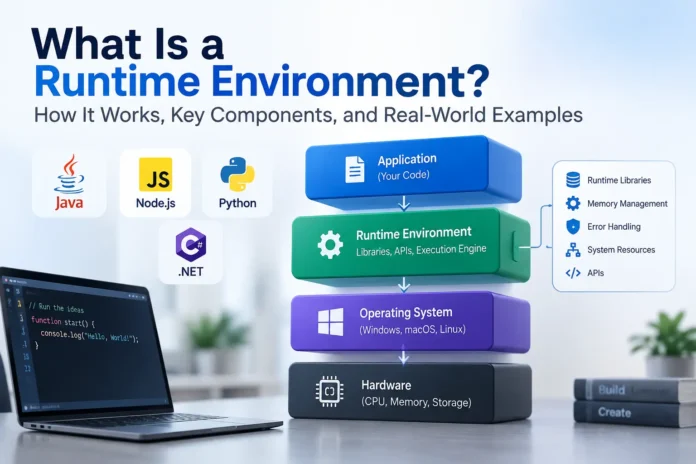
If you’re wondering what is a runtime environment, think of it as the software setup that gives a program everything it needs to run properly. Code alone isn’t enough. A program also needs access to memory, system resources, libraries, APIs, and the operating system.
A runtime environment (RTE) provides these resources while a program is executing. Depending on the programming language, it may also handle memory management, error handling, code interpretation, and communication between the application and the underlying system.
Common examples include the Java Virtual Machine (JVM) for Java applications, Node.js for running JavaScript outside a web browser, and CPython for executing Python programs. Each works differently, but they serve the same basic purpose: providing the environment a program needs while it runs.
What Does “Runtime” Mean?
In programming, runtime refers to the period when a program is actually executing. It is different from compile time, which occurs when source code is being translated or prepared for execution.
Imagine writing a program and saving the source code on your computer. At that point, the program is not necessarily doing anything. When you launch it and its instructions begin executing, it has entered runtime.
The runtime environment provides the conditions the program needs during that period.
This may include:
- Memory allocation and management
- Runtime and standard libraries
- File and network access
- Input/output (I/O)
- APIs and system calls
- Exception and error handling
- Security and permissions
- Access to environment variables
- Resource cleanup
The exact responsibilities depend on the language and runtime being used.
How Does a Runtime Environment Work?
A runtime environment sits between an application and some of the lower-level resources it needs. The exact execution path differs between programming languages, but a simplified model looks like this:
Source code → Compiler or interpreter → Runtime environment → Operating system → Hardware
Suppose a program needs to open a file. Instead of controlling a storage device directly, the program normally uses an API or library. Eventually, the request reaches services provided by the operating system, which manages access to the underlying hardware.
A runtime can also perform work that is specific to a programming language.
For example, a managed runtime may allocate memory on the heap, track objects that are no longer needed, and recover their memory through garbage collection. It may also manage exceptions, load libraries, verify code, or perform Just-in-Time (JIT) compilation.
This abstraction is one reason developers can concentrate on application logic instead of handling every hardware-level operation themselves.
What Are the Main Components of a Runtime Environment?
There is no universal list of components included in every runtime environment. However, several features are common.
1. Execution Engine
The execution engine is responsible for getting program instructions executed. Depending on the runtime, this can involve an interpreter, a virtual machine, JIT compilation, native machine code, or a combination of these approaches.
2. Memory Management
Programs need RAM while they run. A runtime may help allocate memory for variables and objects and release resources when they are no longer required.
Managed environments such as the JVM and .NET’s Common Language Runtime (CLR) can use garbage collection to automate part of this process.
3. Runtime Libraries and APIs
Applications routinely need functions that aren’t written from scratch each time. Runtime or standard libraries can provide common functionality for strings, files, collections, networking, mathematical operations, dates, and other tasks.
APIs also give applications controlled ways to communicate with runtime or operating-system services.
4. Error and Exception Handling
Problems can occur after a program starts. Missing files, invalid operations, memory problems, and unavailable resources can all produce errors at runtime.
Many runtime systems provide structured mechanisms for raising, catching, logging, and handling exceptions.
5. System and I/O Access
Applications often need to read files, receive keyboard input, connect to a network, or communicate with another process. The runtime can provide libraries and interfaces through which these operations are requested.
Examples of Runtime Environments
Understanding runtime environments becomes easier when you look at real technologies.
Java and the JVM
Java provides one of the best-known runtime models.
Java source code is typically compiled into bytecode, which can then be executed by a Java Virtual Machine (JVM). The JVM provides the execution layer and includes services such as memory management and garbage collection.
The wider Java runtime also provides libraries and components required by Java applications. This architecture is closely associated with Java’s portability because JVM implementations exist for different operating systems.
Oracle’s Java Virtual Machine documentation provides technical documentation for the JVM and Java HotSpot VM.
It is also useful to distinguish the common Java terms:
JDK (Java Development Kit) provides tools for developing Java software.
JVM (Java Virtual Machine) executes Java bytecode.
JRE (Java Runtime Environment) traditionally refers to the runtime components needed to run Java applications.
Node.js
JavaScript originally became widely used inside web browsers, where the browser provides an execution environment along with Web APIs.
Node.js allows JavaScript to run outside the browser and provides APIs for tasks such as filesystem and network operations. The official Node.js website describes Node.js as an open-source, cross-platform JavaScript runtime environment.
Node.js is built on the V8 JavaScript engine and uses an event-driven architecture. Its runtime environment provides capabilities that ordinary browser JavaScript does not expose in the same way.
This is a good example of why the language and the runtime environment are not the same thing. JavaScript is the programming language; Node.js is one environment in which JavaScript can execute.
Python
Python programs also need an implementation capable of executing Python code. CPython is the reference and most widely used implementation of Python.
When a Python script is run with CPython, the interpreter and supporting runtime machinery execute the program and provide access to Python’s built-in features and standard library.
The official Python documentation covers the interpreter, language reference, standard library, modules, and other components involved in using Python.
Runtime Environment vs. Compiler vs. Interpreter
These terms are closely related, but they do not mean the same thing.
| Concept | Main purpose |
| Runtime environment | Provides the environment and services required while software executes |
| Compiler | Translates source code into another form, often machine code or intermediate code |
| Interpreter | Executes or processes program instructions |
| Virtual machine | Provides an abstract machine on which code can execute |
| Operating system | Manages hardware, processes, files, memory, devices, and other system resources |
| Development environment | Provides tools developers use to create and test software |
A runtime environment may contain or work with an interpreter, compiler, or virtual machine, but those terms shouldn’t automatically be used interchangeably.
Runtime Environment vs. Operating System
An operating system and a runtime environment can work closely together, but they operate at different levels.
Windows, Linux, and macOS manage fundamental system resources such as processes, memory, files, devices, and hardware access.
A runtime environment generally operates above the OS and provides services suited to the application or programming language.
For example:
Java application → JVM/runtime → Linux → CPU and memory
The JVM does not replace Linux. Instead, it provides an execution layer for the Java application while relying on the operating system for lower-level resources.
Runtime Environment vs. Development Environment
A development environment is used to build software, while a runtime environment is concerned with running it.
A development setup might include an Integrated Development Environment (IDE), debugger, compiler, source-control tools, and Software Development Kit (SDK).
The runtime environment contains or provides what is needed when the finished application executes.
Java makes the distinction easy to see: the JDK provides development tools, while the JVM and associated runtime components handle execution.
Why Are Runtime Environments Important?
One major benefit of runtime environments is abstraction. Developers can use consistent APIs and language features without writing separate low-level instructions for every piece of hardware.
Runtime environments can also improve portability. A Java application compiled to bytecode, for example, can run on compatible JVM implementations available for different platforms.
They can also provide memory and resource management, standard libraries, security mechanisms, exception handling, and predictable execution behavior.
That doesn’t mean every program is automatically cross-platform. Native dependencies, CPU architecture, operating-system APIs, runtime versions, and configuration can still affect compatibility.
What Causes Runtime Environment Problems?
Sometimes an application works perfectly on one computer but fails on another. The runtime environment is often part of the reason.
In web applications, server-side failures can also surface as errors such as a 502 Bad Gateway.
A program may depend on a particular runtime version or library that is missing from the second machine. Common causes include:
- Missing or incompatible dependencies
- Wrong runtime versions
- Incorrect environment variables
- Operating-system differences
- CPU architecture incompatibility
- Missing permissions
- Library conflicts
- Memory limitations
- Unsupported APIs
These issues help explain the familiar developer problem: “It works on my machine.”
For example, an application built for a particular Java version may behave differently if the expected Java runtime components aren’t available. A Node.js application can also depend on a specific Node version or package configuration.
Runtime Environments in Modern Development
Runtime environments are no longer limited to traditional desktop applications.
Web browsers provide runtimes for JavaScript and WebAssembly. Servers can use environments such as Node.js, Python, Java, or .NET. Cloud platforms also provide managed runtimes in which developers deploy applications without directly maintaining every part of the underlying server.
Containers add another layer to this picture. A container can package an application together with libraries, configuration, and dependencies so that its execution environment is more consistent across systems. A container, however, should not simply be treated as another word for a programming-language runtime.
Serverless platforms work similarly at a higher level: developers choose supported language runtimes while the cloud provider manages much of the underlying infrastructure.
Final Thoughts
A runtime environment is the bridge between program code and many of the resources needed to execute it. It can provide an execution engine, runtime libraries, APIs, memory management, error handling, and access to operating-system services.
Different languages use different runtime models. Java relies on the JVM and its runtime ecosystem, Node.js provides a server-side JavaScript runtime built on V8, and CPython provides the standard interpreter implementation used to run Python programs.
Once you understand that relationship, terms such as compiler, interpreter, virtual machine, runtime library, operating system, JRE, JVM, Node.js, CPython, and CLR become much easier to distinguish.
Frequently Asked Questions
What is a runtime environment in simple terms?
A runtime environment is the software environment that provides the resources and services a program needs while it is running.
Is an operating system a runtime environment?
An operating system provides an execution environment at the system level, but in programming discussions, a runtime environment usually refers to a software layer or set of services used by an application above the OS.
Is Node.js a runtime environment?
Yes. Node.js is a cross-platform JavaScript runtime environment built on the V8 JavaScript engine.
Is JVM a runtime environment?
The JVM is a virtual machine and core part of Java’s runtime architecture. It executes Java bytecode and provides runtime services such as memory management.
Is Python a runtime environment?
Python itself is a programming language. Implementations such as CPython provide the interpreter and runtime machinery needed to execute Python programs.
What is the difference between compile time and runtime?
Compile time is when source code is translated or prepared for execution. Runtime begins when the program is actually executing.
What is a runtime error?
A runtime error is a problem that occurs while a program is executing rather than during compilation. Examples include unavailable resources, invalid operations, or unhandled exceptions.