


Every ChatGPT prompt feels almost weightless. You type a question, wait a few seconds, and an answer appears.
Behind that simple interaction, however, powerful computers are working inside data centers. Those computers consume electricity, produce heat, and—in some facilities—use water as part of the cooling process.
So, how much water does ChatGPT use?
The best current first-party estimate is surprisingly small. OpenAI CEO Sam Altman has said an average ChatGPT query uses about 0.000085 gallons of water, or roughly 0.32 milliliters.
But you may also have seen claims that ChatGPT uses 10–50 ml per response—or even an entire 500 ml bottle.
Those numbers come from different research, different generations of AI infrastructure, and different ways of measuring water consumption.
The short answer: An average ChatGPT query uses about 0.32 ml of water according to Sam Altman’s 2025 estimate, but there is no independently verified universal amount that applies to every ChatGPT prompt. Older academic estimates for GPT-3 were substantially higher.
Understanding why requires looking at what these numbers actually measure.
How Much Water Does ChatGPT Use Per Query?
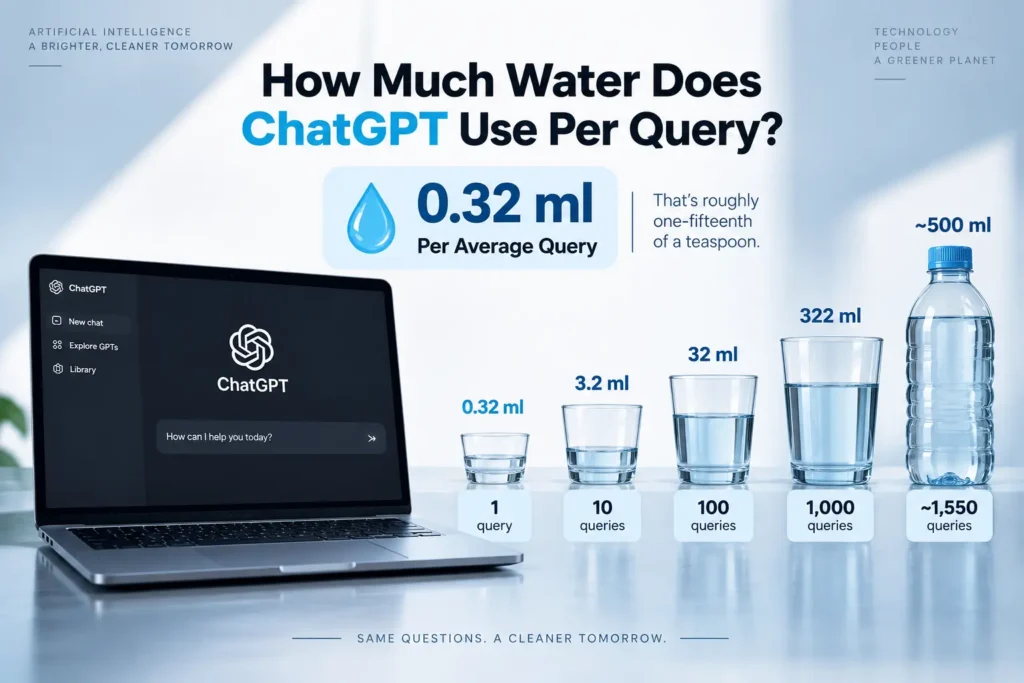
In June 2025, Sam Altman published one of the clearest first-party estimates for ChatGPT’s resource use.
According to Altman, an average ChatGPT query consumes approximately:
0.34 watt-hours of electricity
and
0.000085 gallons of water.
That water figure converts to approximately 0.32 ml, which Altman described as roughly one-fifteenth of a teaspoon.
Using that average, the numbers look like this:
| Number of ChatGPT Queries | Approximate Water Use |
| 1 | 0.32 ml |
| 10 | 3.2 ml |
| 50 | 16 ml |
| 100 | 32 ml |
| 500 | 161 ml |
| 1,000 | 322 ml |
| ~1,550 | ~500 ml |
These figures are simple calculations based on Altman’s reported average.
However, 0.32 ml should not be treated as a universal measurement for every ChatGPT prompt.
Altman’s post did not provide a detailed methodology showing exactly which models, facilities, cooling systems, electricity-related water use, or other infrastructure were included in the calculation.
A simple question and a long reasoning task can also require different amounts of computation.
So 0.32 ml is useful as a current first-party average—not as a fixed rule.
Does One ChatGPT Prompt Really Use a Bottle of Water?
No.
This is probably the biggest misconception surrounding ChatGPT’s water consumption.
You’ve likely seen claims similar to:
“Every ChatGPT question consumes a 500 ml bottle of water.”
That’s not what the research behind the statistic found.
Researchers Pengfei Li, Jianyi Yang, Mohammad A. Islam, and Shaolei Ren studied the water footprint of large AI models. Their research estimated that GPT-3 could consume approximately 500 ml of water for roughly 10–50 medium-length responses, depending on where and when the model was deployed.
You can read the underlying research here:
Making AI Less “Thirsty”: Uncovering and Addressing the Secret Water Footprint of AI Models
Dividing 500 ml across 10–50 responses gives a rough range of:
10–50 ml per response.
Not 500 ml per response.
There is another major limitation: this research modeled GPT-3-era infrastructure, not the latest ChatGPT models running in 2026.
Hardware, model efficiency, cooling technology and data-center infrastructure have changed since then.
Therefore, saying “ChatGPT uses a bottle of water every time you ask a question” is misleading.
Why Do We Have Both 0.32 ml and 10–50 ml Estimates?
At first glance, these numbers look incompatible.
They aren’t necessarily measuring the same thing.
One study might focus on water consumed directly at a data center.
Another might include water consumed while generating the electricity powering that data center.
Researchers may also use different assumptions about server utilization, location, weather, cooling systems and AI hardware.
The underlying technology has changed too.
The widely cited academic study modeled GPT-3, while Altman’s number describes what he called an average ChatGPT query years later.
This creates an important rule when reading AI environmental statistics:
Always check what was measured before comparing the numbers.
A smaller measurement boundary will usually produce a smaller water footprint than a lifecycle calculation that includes more indirect infrastructure.
Where Does ChatGPT Actually Use Water?
ChatGPT itself doesn’t physically consume water.
The infrastructure running it does.
Large language models run on powerful computing hardware installed inside data centers. AI processors perform enormous numbers of calculations and produce heat while doing so.
That heat has to be removed.
There are two particularly important sources of water consumption.
Data Center Cooling
Some data centers use evaporative cooling systems.
Water absorbs heat and some of it evaporates, helping keep computing equipment within safe operating temperatures.
Other facilities use different designs, including air cooling and closed-loop liquid cooling.
This distinction matters because two data centers running similar AI workloads can have very different operational water footprints.
Microsoft, which provides major cloud infrastructure used by OpenAI, says a newer data-center design optimized for AI workloads consumes zero water for cooling during operations. The design recirculates water through a closed-loop, direct-to-chip cooling system instead of relying on continual evaporation.
Microsoft’s explanation of its data-center cooling technology
That does not mean ChatGPT now uses zero water.
It means newer infrastructure can significantly reduce one component of AI’s water footprint.
Electricity Generation
The servers also need electricity.
Generating that electricity can itself consume water, particularly in thermal power generation where water may be required for cooling.
This creates an indirect water footprint.
A data center could therefore consume very little water directly for cooling while still having water associated with the electricity powering its servers.
This is another reason estimates can vary so dramatically.
Water Consumption vs. Water Withdrawal
There is another distinction that gets lost in many articles about AI.
Water withdrawal and water consumption are not the same thing.
Water withdrawal refers to water taken from a source such as a river, reservoir or municipal water system.
Water consumption generally refers to water that isn’t immediately returned to the same local water system, often because it evaporates.
Imagine a facility withdraws 1,000 liters of water and eventually returns 900 liters.
Its withdrawal would be 1,000 liters, but its net consumption would be around 100 liters.
So whenever you see a huge AI water statistic, check whether the source is discussing:
withdrawal, consumption, direct cooling water, electricity-related water, or total lifecycle water.
Using those terms interchangeably can produce misleading comparisons.
How Much Water Did GPT-3 Training Use?

Training an AI model is very different from asking it a question.
Training is the computational process used to develop the model.
Inference happens afterward when the trained model generates an answer for a user.
Training large language models can require enormous computing clusters running for extended periods.
The Making AI Less “Thirsty” research estimated that training GPT-3 in Microsoft’s U.S. data centers could directly evaporate about 700,000 liters of clean freshwater.
That is a model-level training estimate—not the amount consumed when an individual user opens ChatGPT.
This distinction matters because otherwise training footprints can accidentally be presented as per-query footprints.
What Does OpenAI Say About ChatGPT Water Use?
The clearest public figure from OpenAI leadership remains Sam Altman’s June 2025 estimate.
He wrote that an average ChatGPT query uses approximately 0.34 Wh of electricity and 0.000085 gallons of water.
That’s about:
0.32 ml of water per average query.
The figure is useful because it is much newer than GPT-3-era estimates.
But there is an important limitation.
Altman’s short explanation does not provide enough methodological detail to independently reproduce the number or establish precisely which forms of water consumption are included.
For that reason, a careful article should describe it as Altman’s estimate, rather than claiming scientists have conclusively measured every ChatGPT query at exactly 0.32 ml.
ChatGPT vs. Gemini: Which Uses More Water?
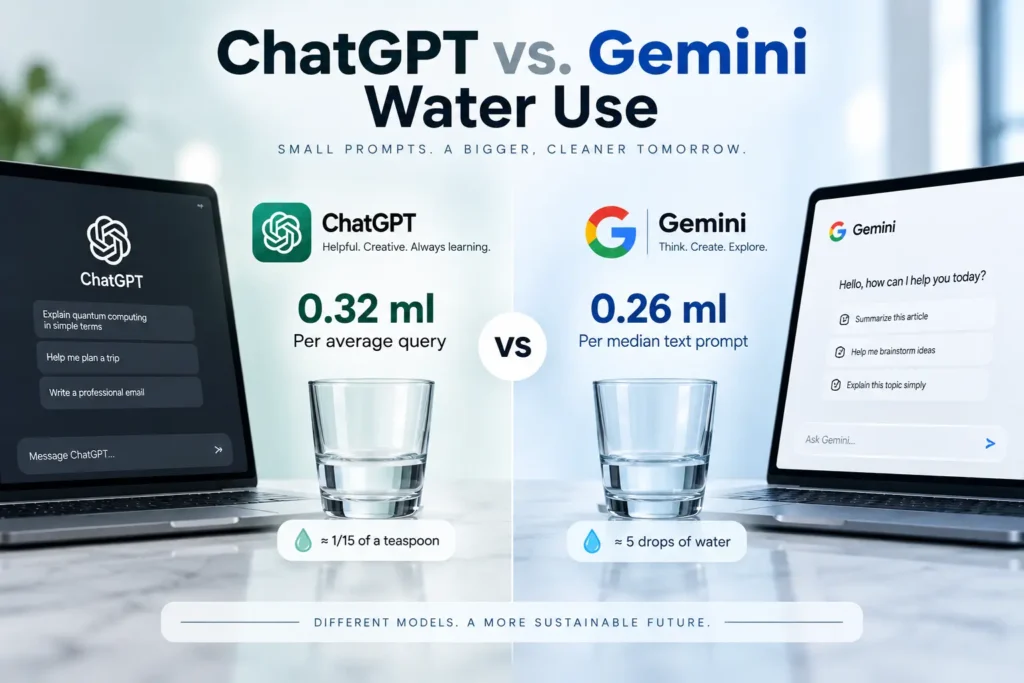
Google provides another useful reference point because it has published a more detailed environmental measurement for Gemini.
Google reported that, based on May 2025 data, a median Gemini Apps text prompt consumed approximately:
| Resource | Median Gemini Text Prompt |
| Energy | 0.24 Wh |
| Carbon emissions | 0.03 gCO₂e |
| Water | 0.26 ml |
Google described 0.26 ml as approximately five drops of water.
Google’s full Gemini environmental-impact methodology
Compare that with Altman’s ChatGPT estimate:
| AI System | Reported Water Use | Source / Measurement |
| ChatGPT | ~0.32 ml per average query | Sam Altman’s estimate |
| Gemini Apps | 0.26 ml per median text prompt | Google’s May 2025 measurement |
| GPT-3 | ~10–50 ml per medium-length response | Academic modeled estimate |
It would be tempting to look at 0.26 ml versus 0.32 ml and conclude that Gemini uses less water than ChatGPT.
That comparison would be too simplistic.
Google and OpenAI haven’t provided identical measurement methodologies. The systems also use different models, hardware and infrastructure.
Google itself notes that its findings represent a point-in-time analysis and don’t describe the impact of every Gemini prompt.
The figures are useful for context, but they are not a controlled ChatGPT-vs-Gemini benchmark.
Why Does the Model Matter?
Not every AI request requires the same amount of computation.
A short factual question may be relatively simple.
A complex task that generates a long response, analyzes large amounts of information or uses additional reasoning can require more computational work.
The underlying AI model matters as well.
Different models can vary in architecture, size, efficiency, hardware utilization and how many computational operations are needed to produce a response.
That’s why articles claiming that every GPT model uses an exact number of milliliters per prompt should be treated cautiously unless the number comes with a clear methodology.
There currently isn’t a reliable public formula like:
1,000 tokens = X ml of water.
Real infrastructure is more complicated than that.
Does a Longer ChatGPT Prompt Use More Water?
Potentially, but not according to a simple fixed formula.
Longer inputs and outputs can require additional computation. More complex reasoning may also increase computational demand.
But prompt length is only one variable.
Water consumption can also depend on:
- the model handling the request,
- number of generated tokens,
- hardware efficiency,
- server utilization,
- cooling technology,
- data-center location,
- weather conditions,
- and the electricity supplying the facility.
So it would be misleading to claim that a 2,000-word prompt always uses twice as much water as a 1,000-word prompt.
Public data isn’t precise enough to support that rule.
Why Data Center Location Changes the Answer
Location is one of the most overlooked parts of the AI-water discussion.
The academic GPT-3 research specifically emphasizes that AI’s water efficiency can vary across both location and time.
A data center operating in a cool climate may have different cooling requirements from one operating in a hot region.
Humidity can matter.
Season can matter.
The local electricity grid matters too.
There’s also a broader environmental question: where is the water being consumed?
One liter consumed in a water-abundant region doesn’t necessarily have the same local impact as one liter consumed in an area facing water stress.
That’s why a global “milliliters per prompt” average can never tell the entire story.
Are AI Data Centers Becoming More Water Efficient?
Yes, there is evidence that infrastructure is improving.
Microsoft says its newer AI-optimized data-center design uses closed-loop direct-to-chip cooling that eliminates water evaporation for cooling during operations.
Google has also reported significant efficiency improvements in its AI systems. According to its 2025 analysis, the energy footprint of its median Gemini Apps text prompt fell 33× over a 12-month period, while its carbon footprint fell 44×.
These improvements can come from several layers:
more efficient AI models,
better hardware,
improved software,
more efficient data centers,
and better cooling systems.
But efficiency per query is only half the story.
AI usage is growing rapidly.
Even if each individual request requires fewer resources, total infrastructure consumption can still rise if the number and complexity of AI workloads grow faster.
This is sometimes described as the difference between efficiency and scale.
Does ChatGPT Use More Water Than a Google Search?
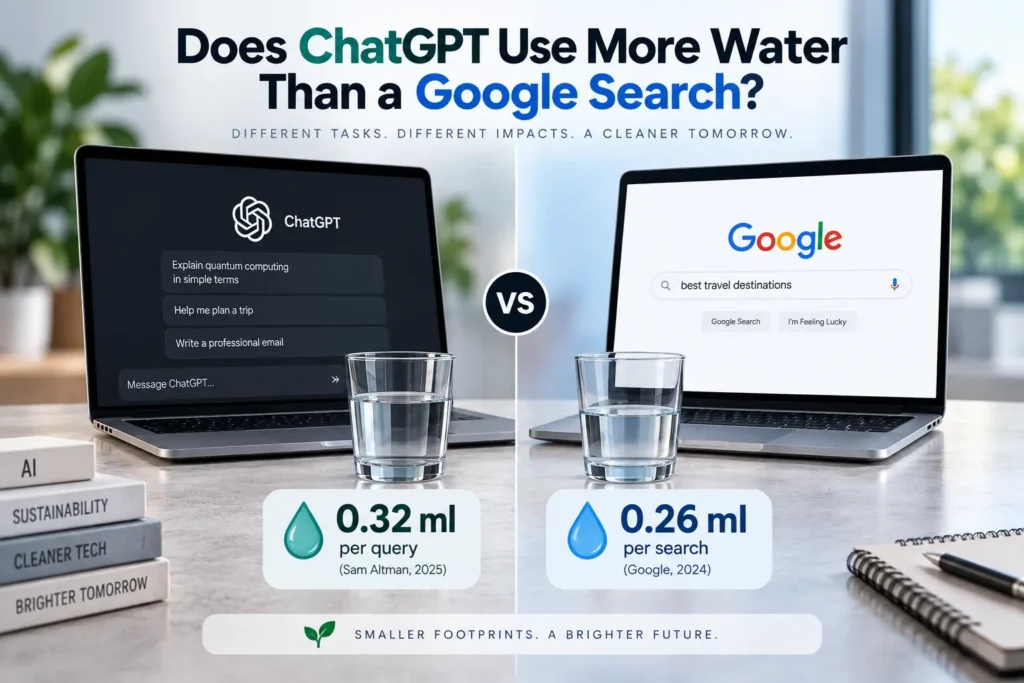
There isn’t enough current, directly comparable public evidence to give a reliable universal ratio.
This is another area where online comparisons often become misleading.
You may find claims that one ChatGPT query equals a certain number of Google searches, but such comparisons frequently combine measurements from different years, infrastructure and accounting boundaries.
Modern AI systems and search engines also continue to change.
A more defensible conclusion is:
Generative AI requires real computing resources, but comparing ChatGPT and Google Search requires measurements made using comparable methodologies and time periods.
Without that, a precise ratio can create more certainty than the evidence supports.
How Much Water Would 100 ChatGPT Questions Use?
Using Sam Altman’s average estimate:
100 × 0.32 ml ≈ 32 ml.
For 1,000 queries:
1,000 × 0.32 ml ≈ 320 ml.
And it would take roughly 1,550 average queries to reach approximately 500 ml under that estimate.
But remember: these are mathematical extrapolations from Altman’s average.
They aren’t measurements of your personal ChatGPT account.
Your actual workload may differ.
Why the Total AI Water Footprint Still Matters
If one average query really requires only a fraction of a milliliter of direct water consumption, it is reasonable to ask why AI water use receives so much attention.
The answer is scale.
A tiny resource requirement multiplied across huge numbers of requests can become meaningful.
AI also requires much more than inference.
There is model training, data-center construction, electricity generation, cooling infrastructure and hardware manufacturing.
And the environmental impact isn’t distributed evenly.
A data center’s local water demand matters much more to the community and watershed where the facility operates than a global average suggests.
So the important environmental question isn’t simply:
“Should I feel bad about asking ChatGPT one more question?”
A more useful question is:
“How efficiently and responsibly is the infrastructure serving billions of AI interactions being built and operated?”
Can ChatGPT’s Water Footprint Be Reduced?
Yes, particularly at the infrastructure level.
Closed-loop cooling can reduce operational water evaporation.
More efficient AI chips can perform more computation for the same amount of energy.
Better model architectures can reduce computational requirements.
Data centers can also consider local water stress when choosing cooling systems and locations.
Google says it uses watershed-health assessments to help guide cooling decisions and limit water use in high-stress locations.
Microsoft, meanwhile, says its newer liquid-cooled AI data centers recirculate water through closed loops without evaporating it during cooling operations.
These infrastructure decisions can matter far more than whether an individual user sends one fewer prompt.
So, How Much Water Does ChatGPT Actually Use?
Here is the clearest evidence-based answer:
Sam Altman estimates that an average ChatGPT query uses about 0.32 ml of water.
Older academic research estimated that GPT-3 could consume roughly 500 ml for 10–50 medium-length responses, or approximately 10–50 ml per response, under the conditions and accounting boundaries modeled in that study.
Those figures should not be treated as measurements of the same system.
The GPT-3 research modeled older infrastructure and included broader water considerations. Altman’s newer ChatGPT estimate provides much less methodological detail.
Google’s independently published company measurement adds another useful data point: 0.26 ml for a median Gemini Apps text prompt in its May 2025 analysis.
Taken together, these numbers tell us something more useful than any viral headline:
There is no single universal water-per-AI-prompt figure.
The answer depends on the model, hardware, data center, cooling system, electricity source, location and what the measurement chooses to include.
Final Answer
So, how much water does ChatGPT use?
The most current first-party estimate available puts an average query at about 0.32 ml of water. Older GPT-3 research estimated substantially more—roughly 10–50 ml per medium-length response—but measured an older system using different assumptions.
The viral claim that one ChatGPT question consumes an entire 500 ml bottle of water is not what the underlying GPT-3 research says.
More importantly, there isn’t one fixed water footprint for every AI prompt.
Model efficiency, hardware, cooling technology, electricity generation, location and measurement methodology can all change the answer.
For an individual user, one prompt represents a small amount of water under current first-party estimates. At the scale of global AI infrastructure, however, water consumption remains worth tracking—especially where data centers operate in water-stressed regions.
The number that matters most in the future may therefore not be “How many milliliters does my prompt use?”
It may be:
How efficiently—and transparently—can AI companies serve billions of prompts while reducing their overall environmental footprint?
FAQs
How much water does one ChatGPT query use?
Sam Altman estimates that an average ChatGPT query uses approximately 0.000085 gallons, or about 0.32 ml of water.
Does ChatGPT use 500 ml of water per question?
No. The widely cited academic research estimated approximately 500 ml for 10–50 medium-length GPT-3 responses, not for one response.
Why does ChatGPT need water?
The computers running ChatGPT generate heat. Some data centers use water-based cooling, while electricity generation can create an additional indirect water footprint.
Does ChatGPT physically consume water?
No. ChatGPT is software. Water consumption comes from the physical data center and energy infrastructure that runs AI models.
How much water do 100 ChatGPT questions use?
Using Sam Altman’s average estimate, 100 queries would correspond to roughly 32 ml of water. Actual resource use can vary by workload and infrastructure.
How much water does Gemini use?
Google reported approximately 0.26 ml for a median Gemini Apps text prompt based on May 2025 data and its published methodology.
Does AI training use water?
Yes. The GPT-3 water-footprint study estimated approximately 700,000 liters of direct freshwater evaporation associated with training GPT-3 in Microsoft’s U.S. data centers.
Are newer AI data centers reducing water use?
Some are. Microsoft says its newer AI-optimized design uses closed-loop direct-to-chip cooling with zero water evaporation for cooling during operations.